












Consultancy and training in electromagnetic compatibility



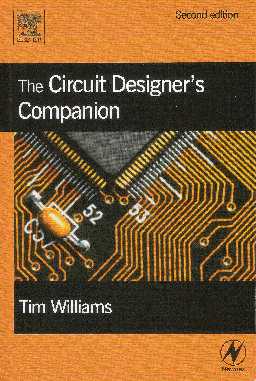
The Circuit Designers' Companion
Second Edition (published 2005)
By Tim WilliamsThis is a compendium of practical wisdom concerning real world aspects of electronic circuit design gathered during years of experience in industry. The Companion enables circuit designers to produce more effective working circuits. Valued by linear and digital designers alike, this guide explains and outlines solutions that take into account the imperfect behaviour of real components, interconnections and circuits.
Electronic circuit design can be divided into two areas: the first consists in designing a circuit that will fulfil its specified function, sometimes, under laboratory conditions; the second consists in designing the same circuit so that every production model of it will fulfil its specified function, and no other undesired and unspecified function, always, in the field, reliably over its lifetime. Designers who can appreciate the techniques and tools used in the latter area are becoming increasingly valuable. The aim of this book is to help such people.
The subjects covered include grounding, printed circuit design and layout, the characteristics of practical active and passive components, the difference between ideal and practical linear ICs, logic circuits and their interfaces, power supplies, electromagnetic compatibility, safety and thermal management. The implications of how to design for manufacturability and to cost are stressed throughout. The style is direct and lucid, providing straightforward practical advice. This is the ideal guide to real world design for both students and practitioners.

CONTENTS: Grounding and wiring; Printed circuits; Passive Components; Active components; Analogue integrated circuits; Digital circuits; Power supplies; Electromagnetic compatibility; General product design. An appendix for some relevant standards, bibliography and index are included.
READERSHIP: Electronic circuit designers, student, practitioner and enthusiast
READERSHIP: Electronic circuit designers, student, practitioner and enthusiast
Some nice reviews on Amazon:
"Have had the book for only one week as a reference at work and I've already used it several times. Highly recommended. It is actually more useful than (and works faster than) the internet."
"the book is so comprehensive, rather than having to bookmark/search for a dozen different web sites each covering the equivalent of a few chapters of the book, you just have to crack open this one tome and it's all covered."
"I have learned more "secret" knowledge from this book than I have from two degrees, an apprenticeship, and twenty five years experience....and that was from SKIPPING AROUND IN THE BOOK. I haven't nearly finished it yet.."
"I showed this book to my EE friends, and they all wanted to steal it. I had some of them over to play cards one night when I had just got the book in. They saw it and spent the rest of the evening going through the book looking for the "new bits" while I worked on my website. Gotta love engineers."
"goes well beyond the BSEE curriculum and focuses almost entirely on no-BS practical knowledge and guidelines. This book is highly recommended for BSEE students or professionals. If I had this book as a BSEE student, it would helped explain a lot of the oddities I found during EE lab experiments."
The first edition was out of print for several years. This is the revised and updated second edition, published at the beginning of 2005. Now out of print again, but available secondhand from | Amazon.co.uk |
There is now (since November 2011) a third edition available, edited by Peter Wilson of Southampton University. It is ISBN 9780080971384, listed in Elsevier's catalogue and also available at Amazon.
"Have had the book for only one week as a reference at work and I've already used it several times. Highly recommended. It is actually more useful than (and works faster than) the internet."
"the book is so comprehensive, rather than having to bookmark/search for a dozen different web sites each covering the equivalent of a few chapters of the book, you just have to crack open this one tome and it's all covered."
"I have learned more "secret" knowledge from this book than I have from two degrees, an apprenticeship, and twenty five years experience....and that was from SKIPPING AROUND IN THE BOOK. I haven't nearly finished it yet.."
"I showed this book to my EE friends, and they all wanted to steal it. I had some of them over to play cards one night when I had just got the book in. They saw it and spent the rest of the evening going through the book looking for the "new bits" while I worked on my website. Gotta love engineers."
"goes well beyond the BSEE curriculum and focuses almost entirely on no-BS practical knowledge and guidelines. This book is highly recommended for BSEE students or professionals. If I had this book as a BSEE student, it would helped explain a lot of the oddities I found during EE lab experiments."
The first edition was out of print for several years. This is the revised and updated second edition, published at the beginning of 2005. Now out of print again, but available secondhand from | Amazon.co.uk |
There is now (since November 2011) a third edition available, edited by Peter Wilson of Southampton University. It is ISBN 9780080971384, listed in Elsevier's catalogue and also available at Amazon.
0750663707 341pp 2005 £29.99
- Books
- CDC


Copyright © 2020 by Elmac Services · All Rights reserved